
Book direct
Villa Périgord
Saint-Vincent-de-Cosse · 19 km away
A great base for river days, castles and Sarlat.
View propertyvillage · Périgord Noir
Limeuil is a steep riverside village at the meeting of the Dordogne and Vézère, with an upper medieval centre, panoramic gardens and useful access to both valleys.

Limeuil stands where the Vézère joins the Dordogne, its stone houses climbing the hillside above the former river port. The confluence explains both the village's setting and its history: this was a place where goods, boats and travellers passed between two important river routes. Today, the riverfront and the upper village offer quite different visits.
You can spend a short stop beside the water, but allow half a day to climb the lanes and visit the panoramic gardens. As a base, Limeuil works particularly well if you want to divide your time between the Dordogne valley and the prehistoric sites around Les Eyzies. It is a small village rather than a service town, so plan on using nearby Le Bugue for larger shops.
Where to stayBook direct
Saint-Vincent-de-Cosse · 19 km away
A great base for river days, castles and Sarlat.
View property
Sarlat-la-Canéda · 26 km away
Watch the Sarlat market from your window.
View propertyOwners
List directly with Dordogne Direct and hear from guests yourself. No commission and no guest service fees.
List your propertyStart at the former port beside the confluence. This lower part of Limeuil has the broadest open space, riverside places to sit and the easiest walking. Two separate road bridges cross the Dordogne and the Vézère here: the village itself occupies the hillside immediately above the meeting of the rivers.
Rue du Port leads you away from the water towards the climbing village streets. Follow the uphill lanes towards Église Sainte-Catherine and the Jardins Panoramiques de Limeuil rather than expecting a level circuit. Houses, stone walls and gateways make this a sequence of enclosed streets, with views opening out as you gain height.
Visitors who stop only at the river miss the upper village, which is the most rewarding part to explore on foot. Chapelle Saint-Martin is a separate stop outside the compact medieval centre, not another building on the climb to the gardens.
The main visit is a walk between the river port and the upper village, with the gardens as a substantial stop rather than a passing viewpoint. These five places give that walk and a short excursion beyond it some shape.
Limeuil's hillside position offered a defensive advantage, while the confluence below made it valuable for trade. Fortifications and a château protected the settlement, and the narrow streets still follow the constraints of a steep, enclosed site. This is why the village feels quite different from the broad riverfront beneath it.
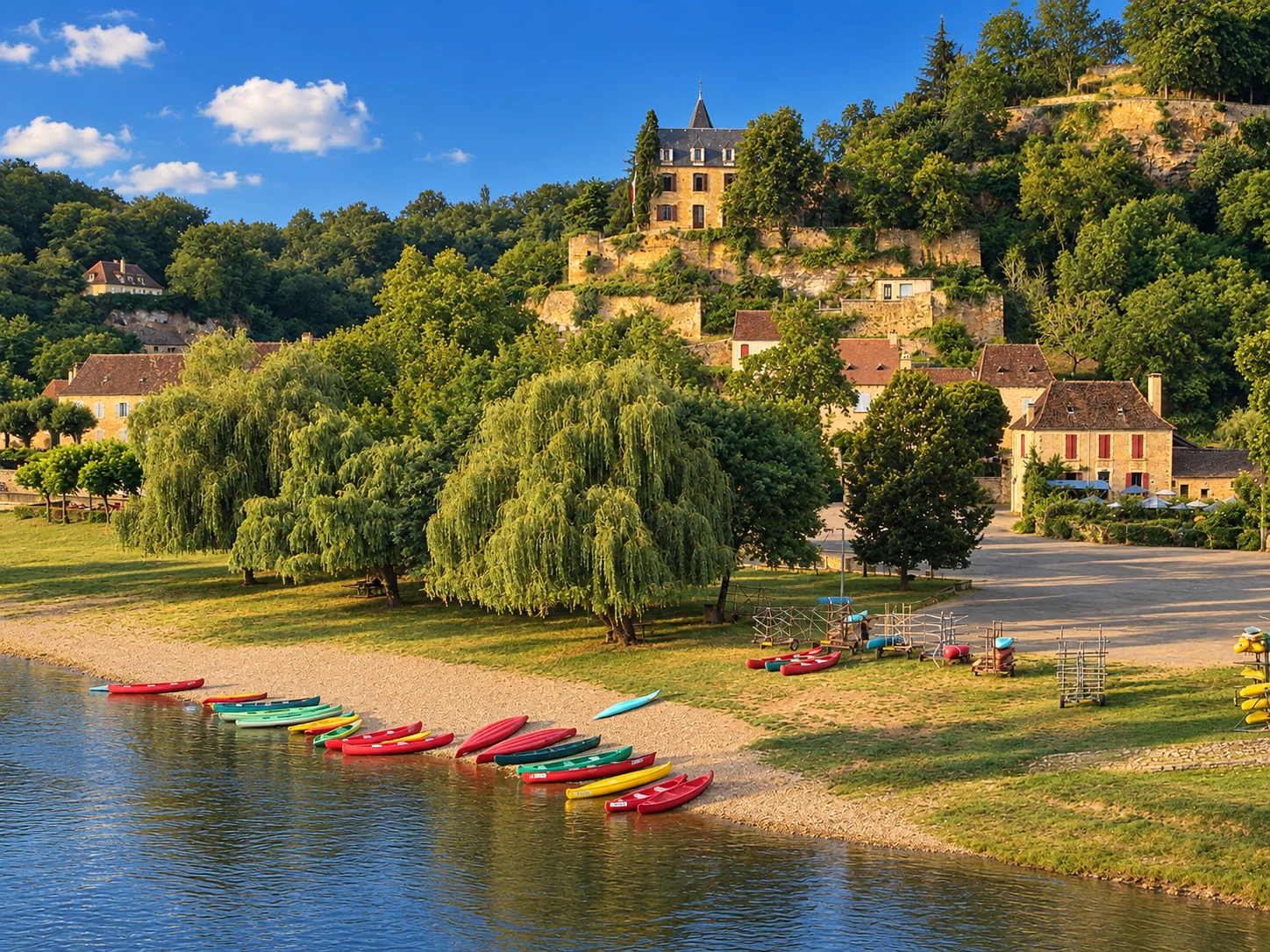
River transport supported Limeuil for centuries. Flat-bottomed cargo boats known as gabarres carried goods along the Dordogne, with the port serving the surrounding area. The growth of roads and railways reduced that role during the nineteenth century, leaving a waterfront whose open space contrasts with the tightly packed houses above.
Chapelle Saint-Martin belongs to an earlier chapter. Its foundation is associated with Henry II and the period following the murder of Thomas Becket in 1170. The panoramic gardens occupy the former château grounds, preserving the commanding position even though the medieval stronghold no longer survives intact.
Limeuil has a small choice of restaurants and cafés, with the riverfront the obvious place to look first. There is enough choice for a meal during a visit, but not the range you would find in a larger town. The choice is narrower outside the main visitor season.
Look for Périgord dishes such as duck confit, magret and potatoes cooked in duck fat, with walnuts appearing in salads and desserts. Seasonal strawberries and walnut cake are useful alternatives if you want something lighter than a full regional meal.
No weekly market is listed for Limeuil in our verified calendar. For a regular food-shopping outing, Le Bugue is the most practical nearby option, about 5 km away, with markets on Tuesday and Saturday.
Trémolat has a Tuesday market, about 7 km away. Le Buisson-de-Cadouin, about 11 km away, has a Friday market and a summer Friday night market. Further afield, Siorac-en-Périgord has a Wednesday market and Saint-Cyprien a Sunday market, both about 13 km from Limeuil. Saint-Cyprien also has a summer Thursday night market.
Shopping in the historic village is mainly small-scale visitor shopping and craft browsing rather than a full range of everyday supplies. There is no supermarket in the village centre, so do not rely on a walk through Limeuil to complete a self-catering food shop.
Use Le Bugue, about 5 km away, for supermarkets, bakeries, pharmacies and a wider choice of everyday shops. Stocking up there before returning to Limeuil is more practical than making separate trips for missing ingredients.
Allow half a day if you want to see both levels of the village and spend time in the gardens. A shorter riverside stop gives you the confluence but not much sense of the upper streets. May, June, September and October are good walking months; July and August bring more visitors to the waterfront.
Use the designated visitor parking rather than driving uphill in search of a space among the houses. The upper village has steep gradients and uneven surfaces, which matter with a pushchair or limited mobility. The lower waterfront is the easier option, but it does not provide a step-free substitute for the full village visit.
A car is useful if you stay here and want to shop or explore both valleys. Treat the confluence as a river environment rather than a swimming pool: currents and water levels matter, even when the banks look inviting. Before travelling, check current garden opening times, seasonal market dates, parking arrangements and any local river-safety notices with the official sources.
Pair Limeuil with Le Bugue if you want a market morning followed by a village walk, or with Trémolat for a day focused on the Dordogne valley. These combinations leave enough time for lunch and the gardens without turning the outing into a succession of brief stops.
For a different subject, head towards Les Eyzies and the Musée national de Préhistoire. Limeuil's river-trading history makes a useful contrast with the much older human story of the Vézère valley. Saint-Léon-sur-Vézère is another option if you prefer a second village and more time beside the river.
If you are based in Limeuil for several days, keep Dordogne-valley and Vézère-valley outings separate. The confluence is a useful starting point for both, but trying to cover both valleys in one day leaves little time for the places themselves.

Prehistory village · Périgord Noir
A village beneath limestone cliffs on the Vézère, home to the National Museum of Prehistory and many nearby sites.

Village · Périgord Noir
A quiet riverside village on a bend of the Vézère, with a Romanesque church and two châteaux.

Hilltop village · Périgord Noir
A hilltop village of towers and medieval lanes, listed among the most beautiful villages of France.
Yes, particularly if you enjoy walking through a small historic village. Its distinguishing features are the Dordogne and Vézère confluence, the steep upper streets and the panoramic gardens. Allow half a day to see more than the riverfront.
The former port sits at river level beside the confluence and two road bridges. Rue du Port and the connecting lanes climb towards Église Sainte-Catherine and the panoramic gardens. The route through the upper village is steep rather than level.
No weekly market is listed in our verified calendar. Nearby Le Bugue, about 5 km away, has Tuesday and Saturday markets. Trémolat has a Tuesday market and Le Buisson-de-Cadouin has a Friday market.
Limeuil is a useful base for exploring both river valleys if you have a car. Choose the village if walking to the waterfront matters, checking the slope and vehicle access for the individual property. Properties in the surrounding countryside suit visitors who prefer more space and are happy to drive for meals and supplies.
The lower riverfront is the easiest part to explore. The upper village involves steep streets and uneven surfaces, so the full walking route will not suit everyone. For the panoramic gardens, establish the current access arrangements directly before planning a visit.
Opening times, prices and parking change. Check before you travel: Jardins Panoramiques de Limeuil, Dordogne Périgord tourism.